
Looking back through the history of packaging, one thing is abundantly clear: for shipping and storing liquids and semi-solids, cylindrical containers have reigned supreme. There are two good reasons for this:
- The arc (think: half-circle) is one of the strongest structural shapes because it evenly distributes stress from a single point across the entire shape.
- Circular barrels, drums, and containers can easily be tipped over and rolled, making transportation easier and more efficient, especially when you’re dealing with large quantities and a limited workforce.
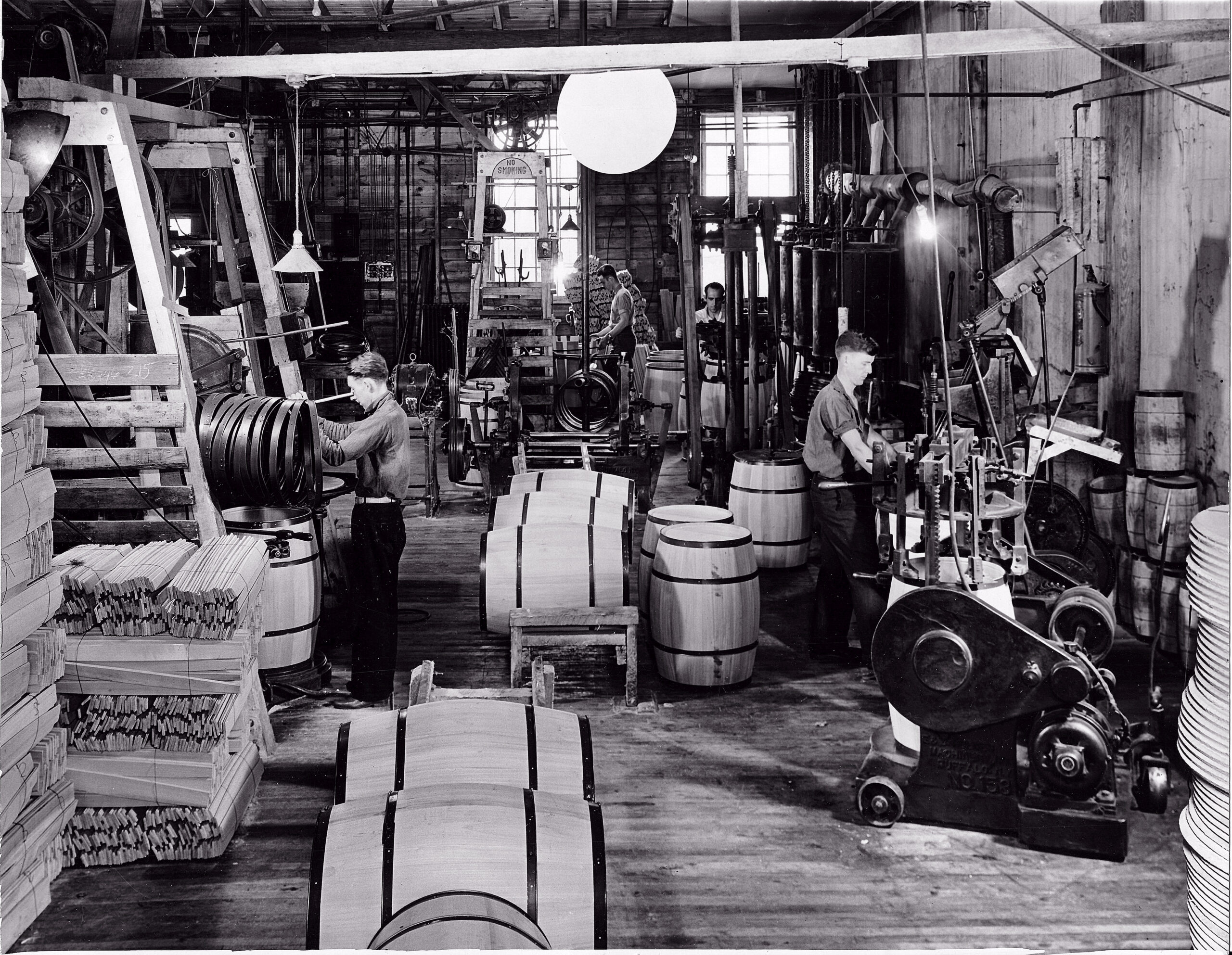
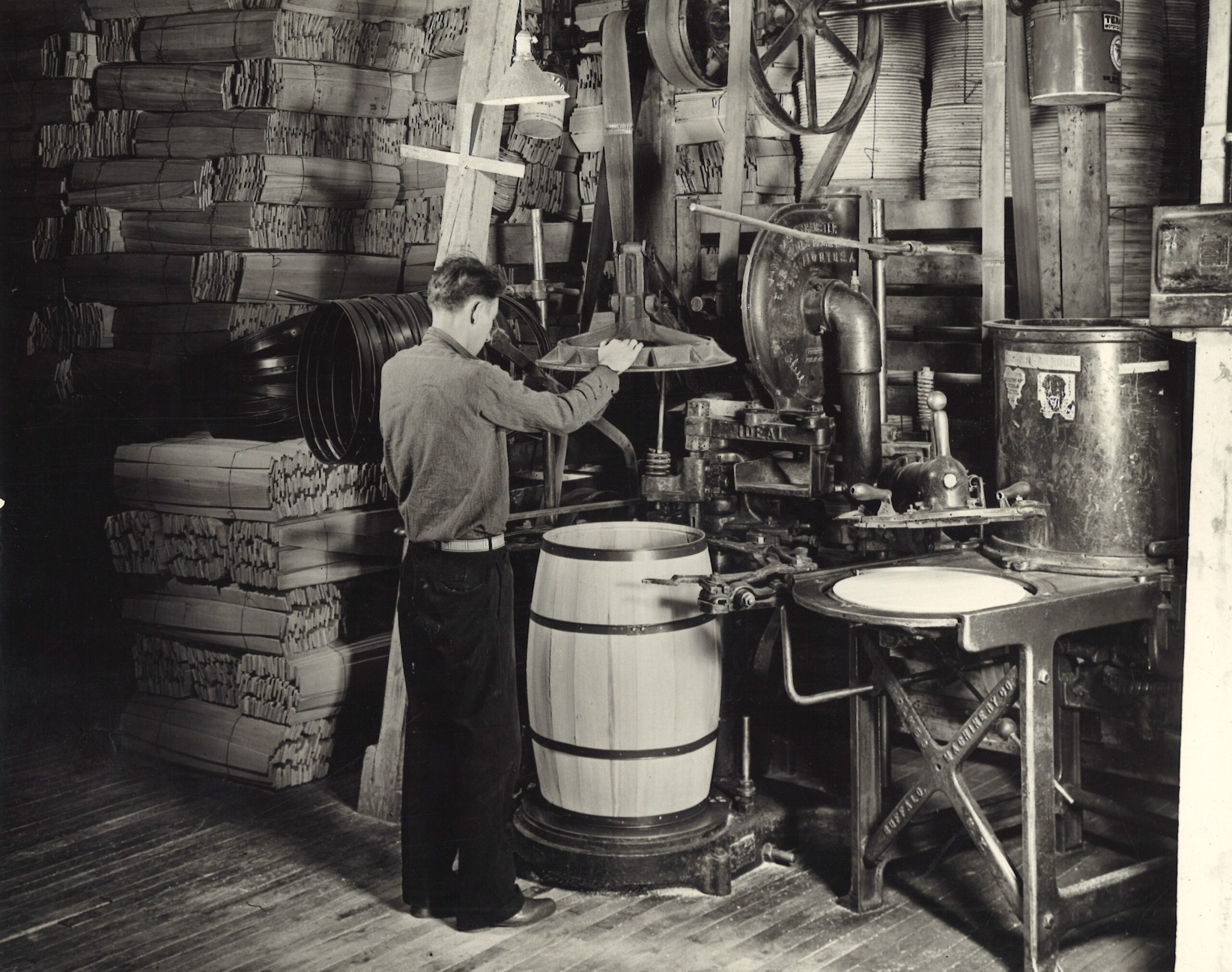
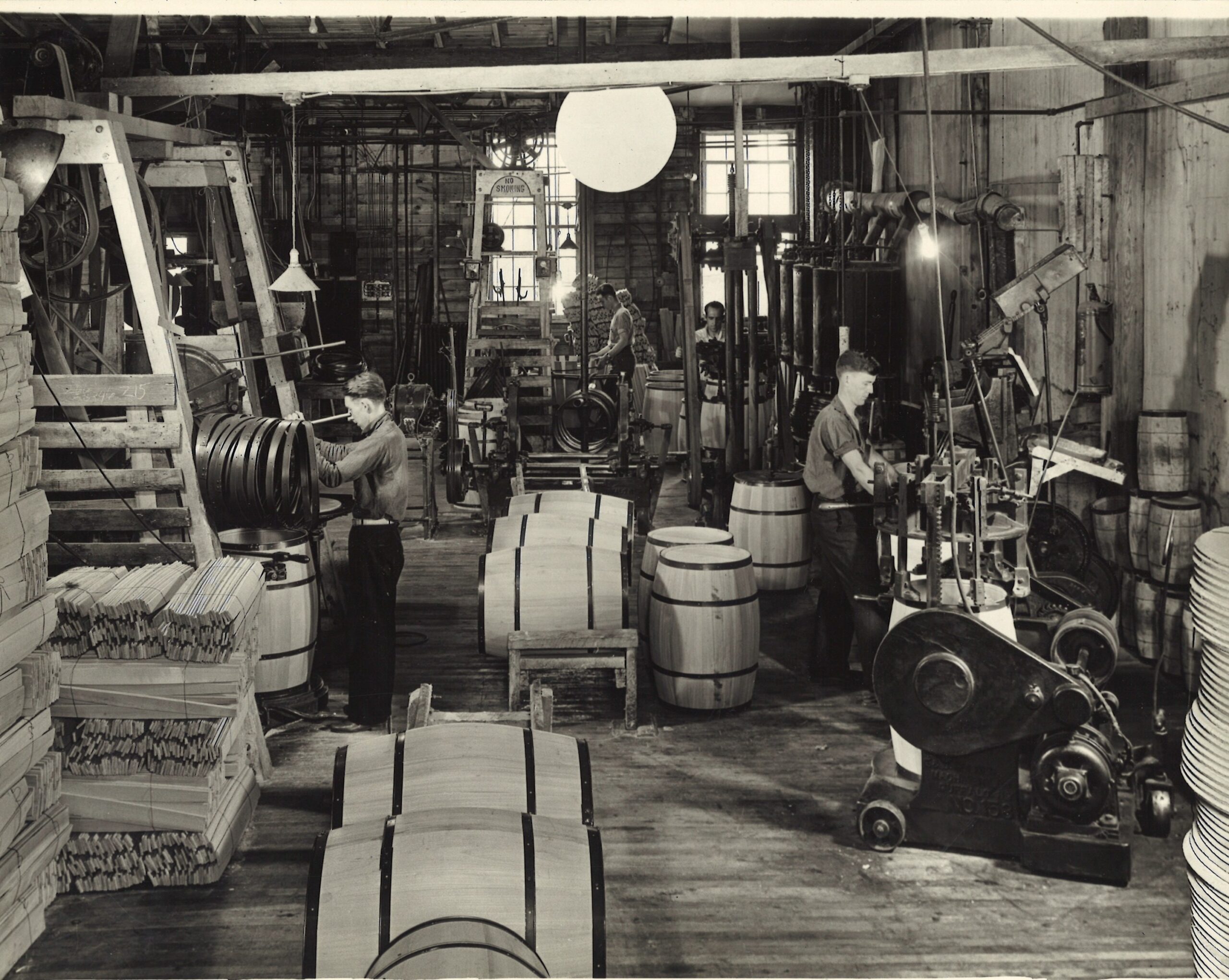
For more than 1,500 years, wood – primarily oak – was the material of choice for these barrels or kegs. Using a stave construction with metal banding, they were strong, could be manufactured pretty much anywhere, and were relatively low-cost. It is no surprise they dominated the packaging landscape from the time of King Arthur until the late 19El century.
What happened in the 19El century?

Oil. Specifically, the Great Oil Boom of 1859.
When oil was struck in Titusville, Pennsylvania, USA, it set in motion a rush to build as many drills and refineries as possible to capture and process this “black gold”. As the name suggests, in the span of a few short years, “rock oil” went from an obscure resource to one of the most expensive commodities in the world. As with all commodities, extraction is one thing. Transportation is another.
Early transportation efforts were silly (even by turn-of-the-century thinking) and downright reckless by today’s efficiency and environmental standards. It included things like floating it down rivers in open-air barges* – think floating logs in the river like the timber industry used to do – or creating leaky pipelines.
*To nobody’s surprise, shipping oil in open-air barges down rivers was a huge disaster. The Wikipedia page on the Pennsylvania Oil Boom cites sources “that estimate one third leaked out of the skiffs before they were even launched, and another third was lost by the time the skiffs reached their destination. That is ‘IF’ the skiffs reached their destination, apparently only three in five of the flimsy vessels survived the trip without being destroyed by collisions with rocks, fallen trees, or other skiffs.”
Which brings us back to the tried-and-true wooden barrel. If it was good enough to ship other precious liquids (whiskey), it was surely good enough to transport oil. In 1866, independent producers met in Titusville and agreed that 42-gallons would constitute a barrel of oil. Part of the reasoning hinged on portability. At 42 gallons, a full barrel of oil weighed roughly 300 pounds, which was on the higher end of what two men could be expected to reasonably maneuver.
FUN FACT: Today, a barrel (42-gallons) of unrefined oil produces 20-gallons of gasoline, 12-gallons of diesel, and 4-gallons of rocket fuel. #TheMoreYouKnow
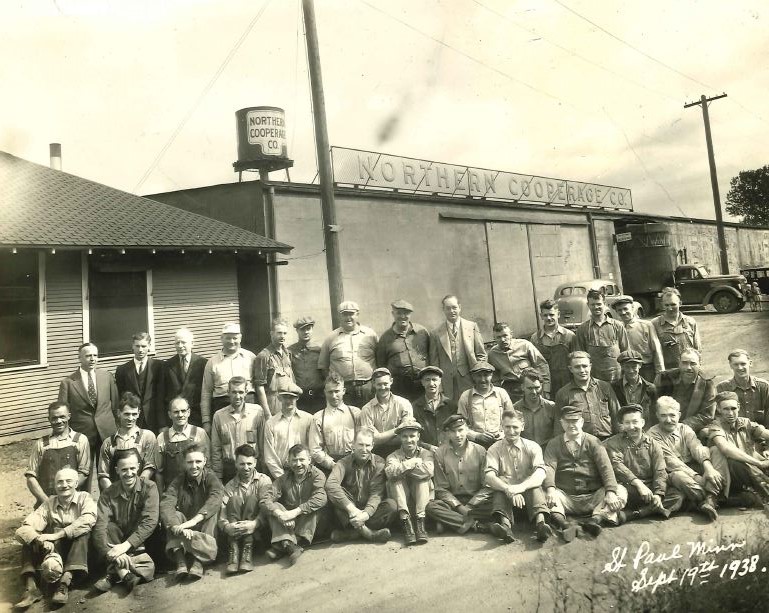
The Trouble with Wood
Despite a thousand-plus years at the top of the packaging food chain, the shortcomings of wood barrels were laid bare with the rapid growth of the oil industry. For one, demand started to outstrip supply. To meet the needs of his growing company, John D. Rockefeller – the founder of Standard Oil – started purchasing large tracts of oak forests in order to ship lumber to Cleveland, OH where it could be made into barrels for his operations. In addition to improving volume and lead times, this vertical integration cut Standard Oil’s cost per barrel from $3 to $1.50. One small, but important part to the company’s early success.
FUN FACT: In 1872, Standard Oil controlled 21 of Cleveland’s 26 refineries, and by the early 1880s, it controlled about 90% of U.S. refineries and pipelines. Greif was founded as “Vanderwyst and Greif Cooperage” in 1877 in Cleveland, OH and by 1908, the Greif Bros. Company was the largest cooperage in the world. Greif has been in the drum business since the very beginning!
Other challenges with wood barrels included weight and leakage. Without getting too far into the weeds, there are two types of coopers (coopers are the trade name for barrel makers), “tight coopers” who specialize in barrels for liquids, and “slack coopers” who specialize in barrels for… You guessed it, non-liquids or dry goods. While both types of barrels struggled with durability, even tight coopers struggled to create leak-proof barrels that could stand up to being transported over great distances and rough conditions.
Add on to that the weight of the material, wood especially wood saturated with liquid is not light. These problems compounded on one another, giving ideas like open-air oil barges a much longer shelf life than they probably deserved.
The First Steel Drums: Standard Oil, Nellie Bly, and Henry Wehrhahn
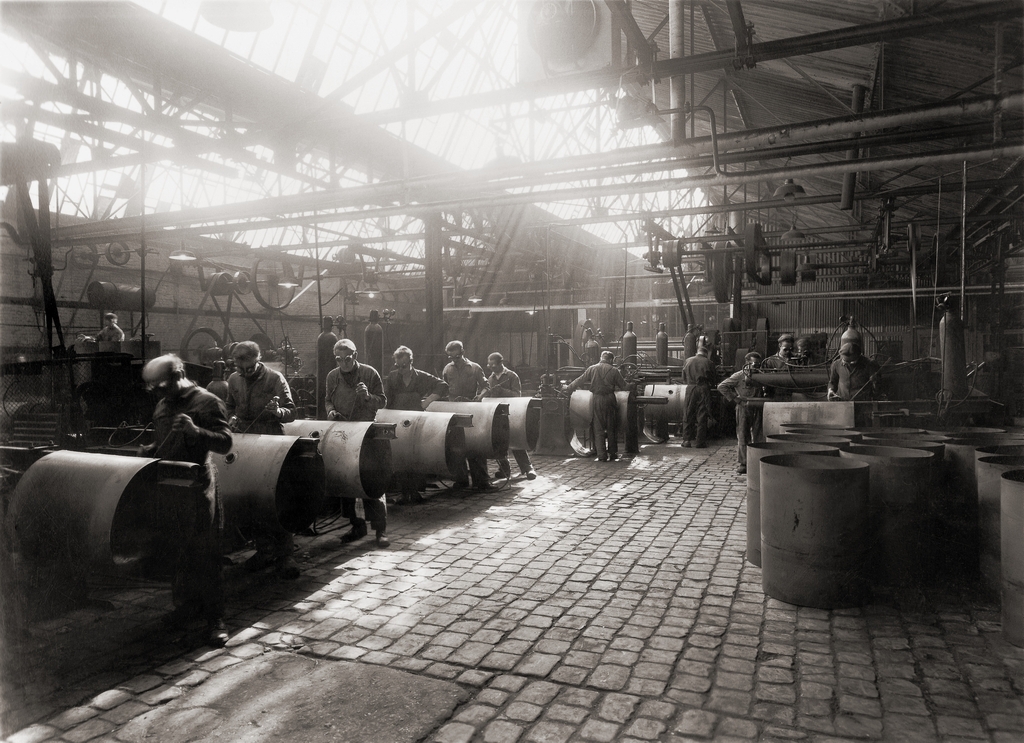
The first attempt at tackling this issue was Standard Oil. Based on similar designs appearing across Europe, the first steel ‘barrels’ commercially manufactured were in Bayonne, New Jersey, in 1902. The bilge-sided barrel used steel sheet metal fastened with rivets. While it solved the durability issue, as you can imagine, it still leaked.
Fast forward to 1905, when a pioneering journalist and manufacturing heir, Nellie Bly – born Elizabeth J. Cochran – introduced the first 55-gallon steel drum.
Nellie Bly
Born in Pittsburgh, Pennsylvania, in 1864, Elizabeth Cochran got her start as a journalist for the New York World, where her pen name, Nellie Bly, stuck. In 1895, she married millionaire manufacturer Robert Seaman and inherited the Iron Clad Manufacturing Co. upon his death in 1904. That same year, on a trip through Europe, she saw steel glycerin containers. The famous quote attributed to her following that trip is “I determined to make steel containers for the American trade”. And sure enough, one year later, she had her patent.
Henry Wehrhahn
In looking at the first patent for the steel barrel (U.S. Patent 790,861 – which included “a means for readily detaching and securing the head of a metal barrel”) was invented by Henry Wehrhahn in 1905. The inventor assigned his patent to the widow of Iron Clad Manufacturing founder, Elizabeth Cochrane Seaman — Nellie Bly.
Shortly thereafter, Wehrhahn received two more patents improving the metal barrel (U.S. Patents 808,327 y 808,413), introducing improved locking mechanisms, integrated flanges, and rolling hoops that allowed barrels to be rolled without injury. Both were also assigned to the Iron Clad company president.
Why the 55-gallon Standard?
If a barrel of oil was set at a 42-gallon (35.0 imp gal; 159.0 L) standard, then where did 55-gallon barrels come from? To answer this, we need to look back at when the standard was set (and why) and then look at how the steel drum changed the game.
When producers convened in Pennsylvania to set the 42-gallon (35.0 imp gal; 159.0 L) standard, it was chosen in part because it was hypothesized that oil was originally transported in whiskey casks, commonly referred to as a ‘tierce’. It is also hypothesized that using this standard allowed British and American merchants to refer to the same unit.
FUN FACT: the 42-gallon tierce was half a puncheon, a third of a butt or a sixth of a tun. #AllGreek2Me
In 1991, Pamela Terry published the book “Fifty-Five Gallons – The History of Steel Drum Reconditioning,” exploring how the jump from 42-gallons to 55-gallons happened:
“Undisputedly, the steel drum was designed as a replacement or improvement of the wooden barrel that had become standardized at 42 gallons in the oil industry. It is reasonable to expect that producers of the new product would try to reduce any problem customers and users might meet in changing over from wooden barrels.
The most critical variable was the diameter of the package, for this dimension determined loading patterns and capabilities on trucks, trailers, barges, and railroad cars. The outside diameter of a standard 42-gallon barrel is about 23 inches; this has been the overall diameter of steel drums practically since their invention. Because drums are straight-sided –not curving inward at both ends, as barrels do – and because steel is much thinner than wood, cylindrical containers made to the same diameter as 42-gallon wooden barrels hold considerably more product.
So, this theory goes, 55 gallons was simply the resulting capacity of steel drums built to the height and width of existing 42-gallon wooden barrels.”
A second theory about the advent of the 55-gallon drum concerns the standard sizes of steel stock and the goal of limiting waste in the manufacturing process. Whether steel mills produced carbon steel rolls in 34 ¾ heights to accommodate steel drums, or steel drums chose 34 ¾ height to accommodate available steel stock, is unknown and sets up a classic chicken-or-the-egg conundrum (pun intended).
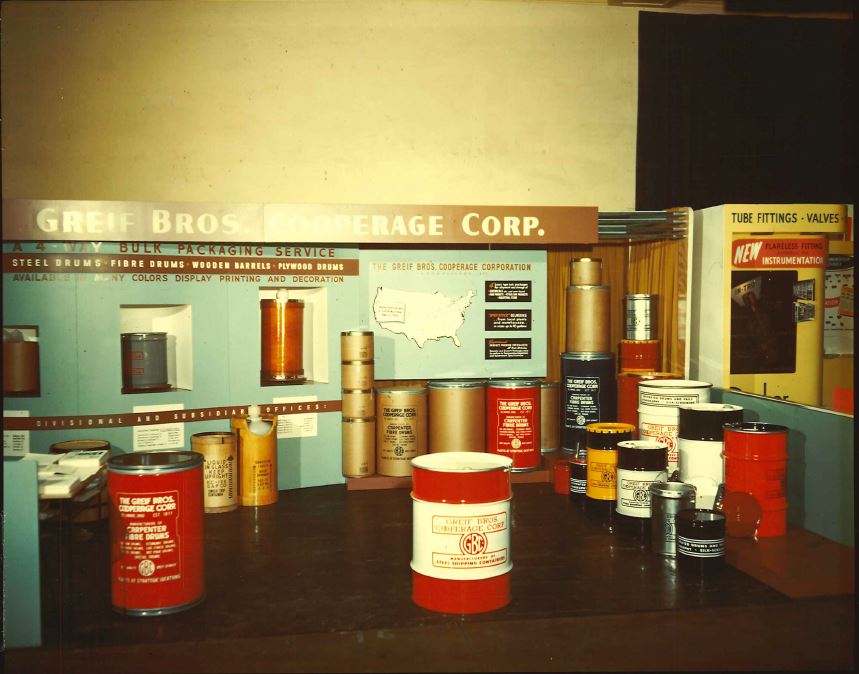
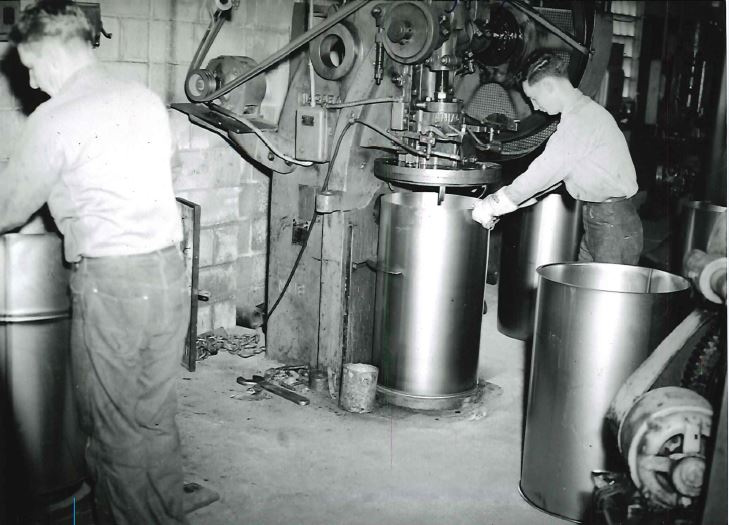
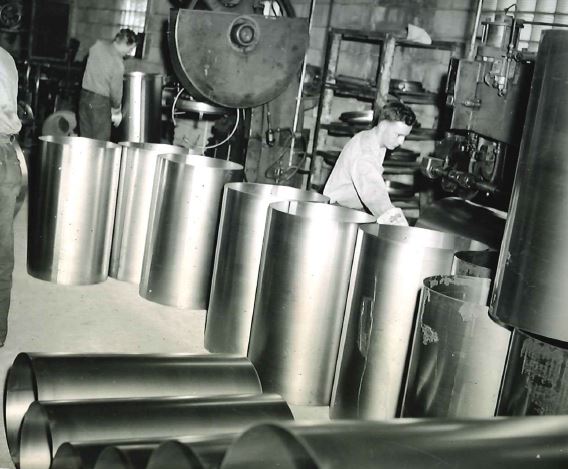
Steel Drums: 1905 to Today
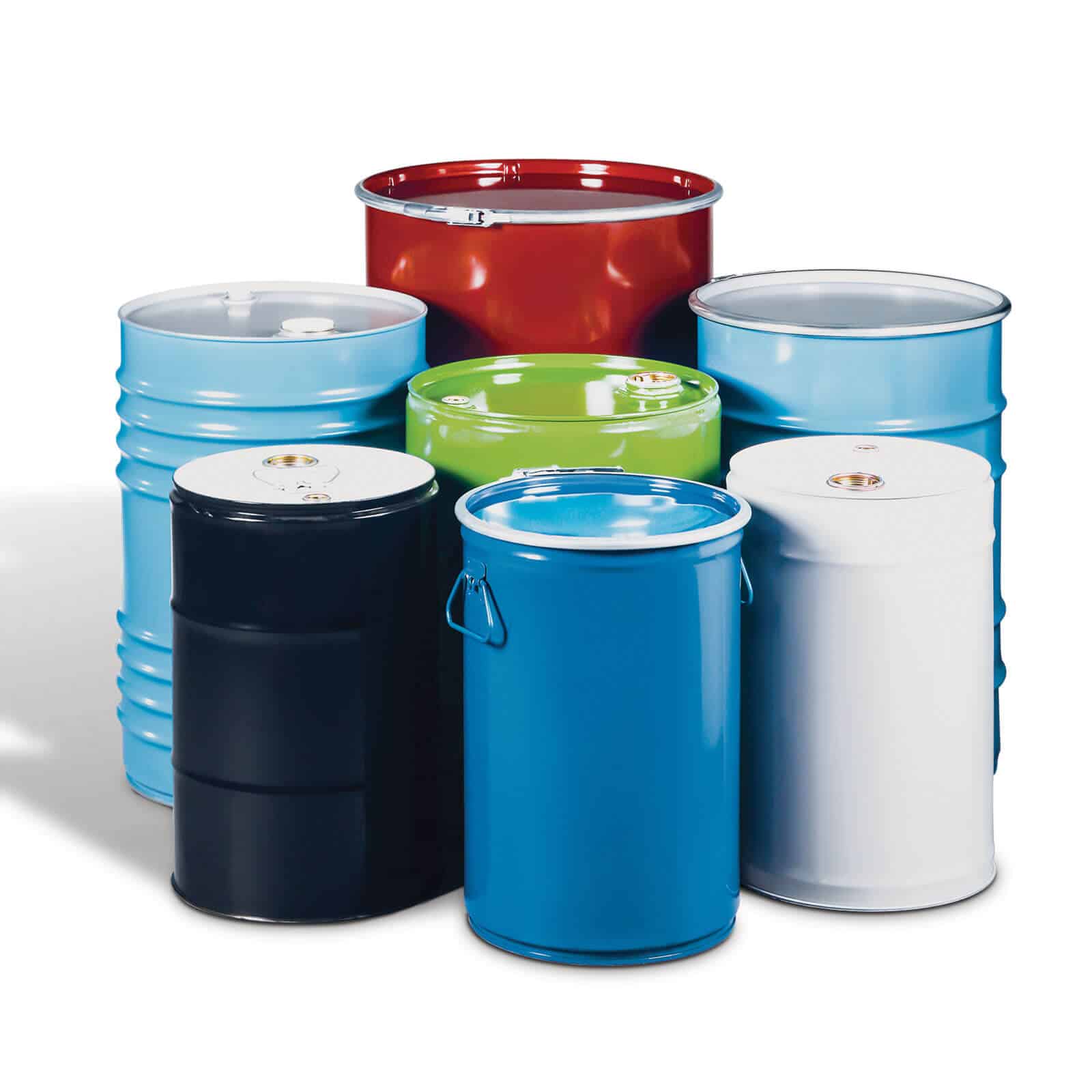
While oil is still referred to in measurements of barrels, the reality is that with the advent of sophisticated pipelines and modern oil tanker trucks and ships, oil is not really shipped in barrels – steel or otherwise – anymore. At least not in the quantities it was during the birth and rapid expansion of the industry. That does not mean they are no longer relevant, in fact quite the contrary is true. Steel drums today come in a variety of sizes with different liners, coatings, and accessories to meet a variety of demands and materials. From nuclear waste to flavors and fragrances, steel drums have only become more relevant for a global society that demands safety and expects quality.
Creating drums for our customers 150 years later
At Greif, we manufacture fully customizable drums with capacities from 8 gallons (30 liters) to over 143 gallons (540 liters). They include options for internal lacquer or liners (including BPA-free options), as well as variable wall, top, and bottom thicknesses to meet even the most demanding of applications.
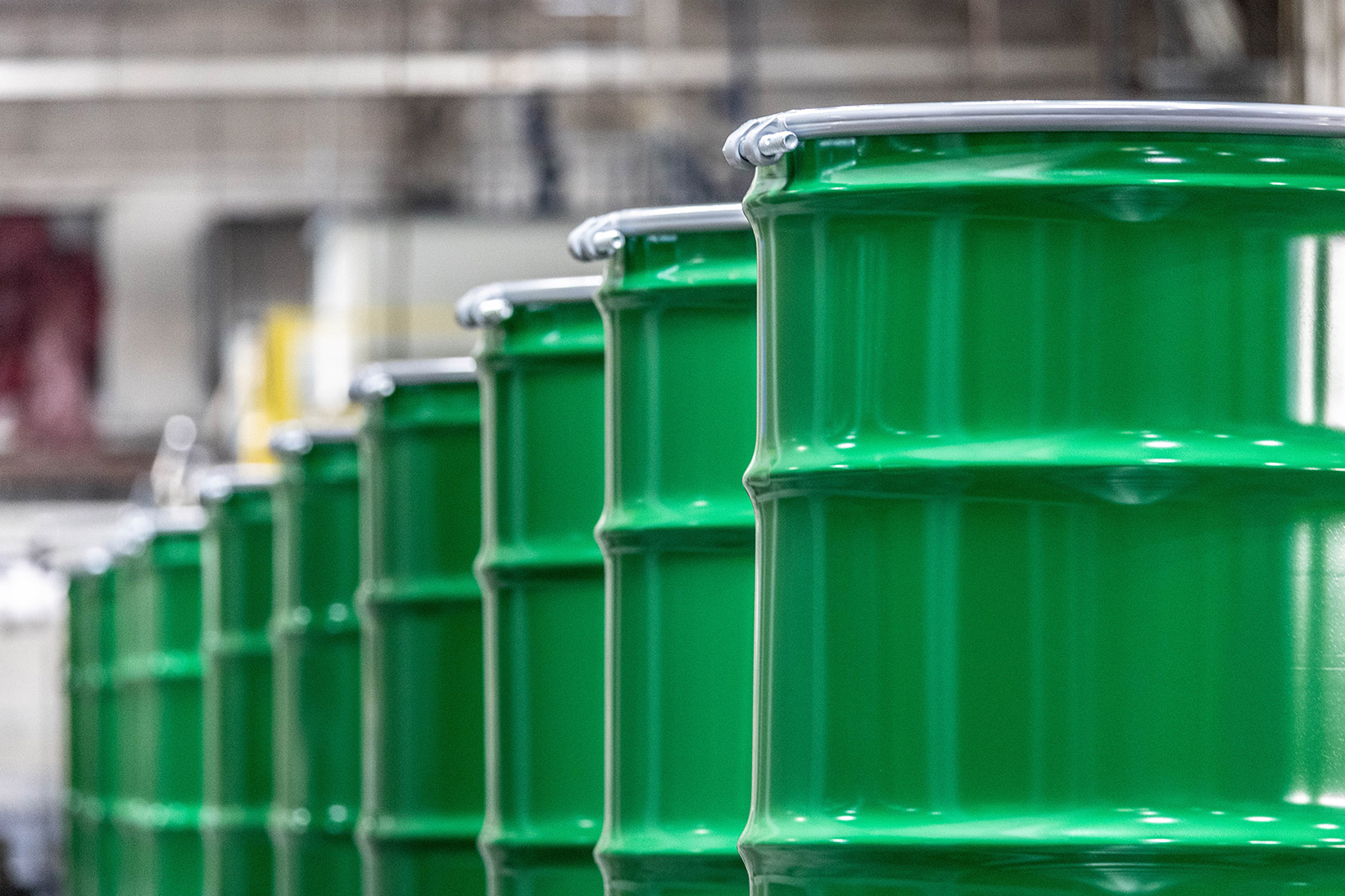
In addition to traditional open-head and tight-head steel barrels, Greif also offers specialty material formulations for specific applications, including agitator, salvage, stainless steel, or composite drums. Customers can also choose from a range of styles with lever-lock or bolt-ring locking bands. Tapered or nestable options offer improved logistics when stacking for transportation.
We’ve come a long way since open-air oil barges, the tierce, and the riveted metal barrels, yet the journey of the steel drum in some ways is really just starting to hit its stride. We’re proud to add our chapter to Nelly Bly’s story in creating packaging solutions for life’s essentials.