
Suchen
Allgemeine Filter

Beyond Headlines: A Science-Based Look at Fluorination and PFAS Whitepaper

Why process chemistry and oxyen control – not speculation – should guide barrier selection

Regulatory frameworks increasingly scrutinize fluorinated packaging for PFAS formation and recyclability impacts. These concerns are legitimate – but they have led to categorical treatment of all fluorination technologies as uniformly high-risk, regardless of process chemistry or extraction testing results.

In-mold barrier technology (IMB) provides a different pathway: fluorination with validated PFAS non-detect results, low total fluorine content, and demonstrated recyclability alignment. The distinction is grounded in process design – specifically, the exclusion of oxygen during the blow molding process.

This paper synthesizes evidence from peer-reviewed research, multi-facility characterization studies, and established fluorination chemistry to demonstrate that IMB provides a validated pathway for applications requiring fluorination barrier performance with demonstrated PFAS-compliant profiles.

For regulatory bodies and technical evaluators: Process-specific validation through reproducible testing data – not categorical assumptions about fluorination – should guide barrier technology assessment.

The Regulatory Challenge: When Categories Cannot Distinguish Chemistry

Regulatory attention to PFAS in packaging reflects appropriate caution about persistent, bioaccumulative compounds. The Association of Plastic Recyclers’ temporary suspension of fluorinated HDPE from design-for-recycling guidance and heightened scrutiny from EU REACH authorities demonstrate that fluorination technologies warrant careful evaluation.

The challenge is that regulatory responses typically treat all methods of fluorination as a single category – applying the same risk framework regardless of manufacturing method and process control measures, oxygen control during the manufacturing process, or empirical safety profiles derived from analytical testing. This creates uncertainty for packaging engineers evaluating technology options, procurement teams facing barrier transitions, and regulatory bodies implementing restrictions based on category labels rather than analytical testing results.

Greif’s in-mold barrier (IMB) offers a data-driven alternative: a fluorination process with extensive validation demonstrating PFAS non-detect results, low total fluorine content, and reproducibility across commercial manufacturing conditions. This paper presents the evidence supporting IMB’s safety profile and demonstrates that manufacturing process-specific validation – not categorical fluorination labels – provides the technical foundation for informed regulatory and engineering decisions.

The Evidence: IMB's Validated Safety and Compliance Profile

2.1 PFAS Detection: Comprehensive Testing Shows Non-Detect Results

Independent Peer-Reviewed Validation

IMB has been evaluated for PFAS leaching in peer-reviewed scientific research published in Environmental Advances1. The study evaluated IMB-treated HDPE containers under accelerated leaching conditions designed to maximize PFAS detection if present, and to be much closer to how the product will be used.

Testing Protocol:

  • Method: Methanol extraction (more aggressive than water-based tests)
  • Duration: 1-12 weeks exposure
  • Analytes: 19 PFAS compounds including PFOA, PFOS, GenX, and shorter-chain perfluorocarboxylic acids (PFCAs)
  • Detection Limits: LOQ (limit of quantification) = 10 ng/L for 18 compounds; LOQ = 20 ng/L for GenX
  • Sample Source: Production containers from commercial manufacturing facilities


IMB Results:

“None of the target PFAS … were detected at or above their respective LOQs at any exposure time point” for IMB¹.

The analytical method used detection limits (10-20 ng/L) consistent with drinking water safety standards and well below regulatory thresholds. PFAS non-detect at these levels indicates absence of measurable PFAS formation, not simply low concentrations.

2.2 Multi-Facility Validation: Reproducibility Across Production Sites

Independent research establishes IMB’s PFAS non-detect profile². The critical validation question is: Are these results reproducible across different facilities, resin sources, and production conditions?

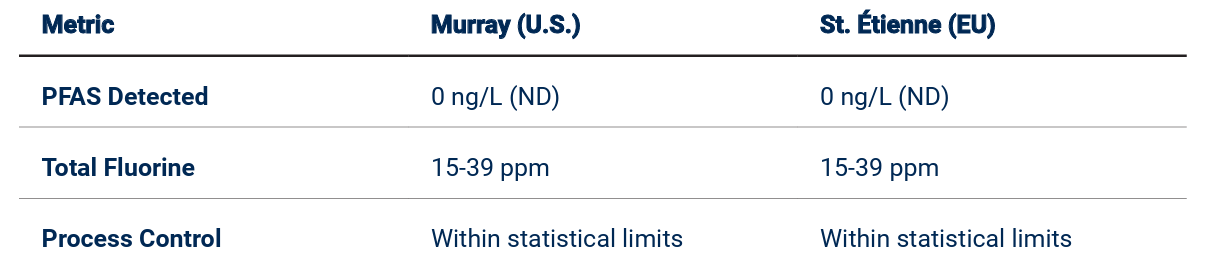
Greif conducted comprehensive PFAS and total fluorine testing across geographically and operationally distinct production facilities.

Facilities Tested:

  • Murray, Kentucky (U.S.): Blow molding facility using North American resin supply chains
  • St. Étienne, France (EU): Blow molding facility using European resin supply chains


Testing Protocol:

  • PFAS Analysis: 19-compound suite consistent with peer-reviewed methodology
  • Detection Limits: LOQ 10-20 ng/L
  • Total Fluorine Analysis: Combustion ion chromatography
  • Sample Source: Production containers from standard operations (not laboratory-optimized batches)


Results:
Results 2.1PFAS e1778171828705

Consistency across different geographic regions, resin suppliers, and production equipment demonstrates that IMB’s PFAS non-detect profile reflects controlled process parameters reproducible in commercial manufacturing – not laboratory-specific conditions.

2.3 Total Fluorine Content: Margin Below Regulatory Screening Thresholds

IMB-treated HDPE consistently measures:

  • Total fluorine: 15-39 ppm

This range provides substantial margin relative to regulatory screening thresholds:

  • EU REACH PFAS Restriction Proposal: 50 ppm total fluorine screening threshold³
  • California SB 343: <100 ppm total organic fluorine for recyclable packaging claims⁴

TotalFluorineContent RangeGraphic

The combination of PFAS non-detect and low total fluorine provides independent, mutually reinforcing validation that IMB does not present the chemical risks that drive regulatory PFAS scrutiny.

2.4 Recyclability Framework Alignment

IMB has been evaluated against established design-for-recycling protocols.

  • RecyClass (European recyclability certification framework)⁵
  • APR Design for Recycling Guidelines (U.S. technical standards)⁶


Performance Against Key Criteria:

  • Polymer Compatibility: IMB fluorination is a nanometer-scale surface treatment. The bulk polymer remains HDPE, ensuring compatibility with HDPE recycling streams.
  • Contaminant Levels: Total fluorine of 15-39 ppm is below the threshold that would affect recycled resin quality. Combined with PFAS non-detect results, IMB does not introduce persistent contaminants into recycling streams.
  • Physical Properties: IMB does not alter container density, sink/float behavior, or optical properties in ways that interfere with standard recycling processes.
  • APR Status: IMB is not currently certified by APR, reflecting APR’s temporary suspension of evaluation for fluorinated HDPE pending broader policy discussions – not technical deficiencies. IMB’s technical data aligns with APR’s design-for-recycling criteria. As APR develops evaluation protocols that distinguish fluorination processes based on PFAS testing and total fluorine content, IMB’s validated profile positions it favorably⁶.
The Mechanism: How IMB Prevents PFAS Formation

Understanding why IMB achieves PFAS non-detect results is essential for regulatory confidence and technical validation.

3.1 The Chemistry of PFAS Formation: Oxygen as the Enabling Reactant

Perfluorocarboxylic acids (PFCAs) – the primary PFAS class of concern in fluorinated packaging – form when fluorination occurs in the presence of oxygen. When polymers such as HDPE are exposed to gaseous mixtures of fluorine and oxygen (oxyfluorination), oxygen participates directly in the surface reaction, leading to the formation of carbonyl-containing groups, including acyl fluoride (–COF) functionalities, within the polymer surface⁷ ⁸.

These – COF groups are chemically unstable in ambient conditions and readily hydrolyze upon exposure to atmospheric moisture, converting to carboxylic acid (–COOH) groups. This reaction pathway explains the formation of PFCA species during oxygen-exposed fluorination processes.

The Reaction Sequence:

  1. Direct fluorination (oxygen excluded).
    Fluorine gas (F₂) reacts spontaneously with the HDPE surface at room temperature in an exothermic reaction. Formation of the fluorinated surface layer is diffusion-controlled, with the reaction rate governed by the diffusion of fluorine through the already-fluorinated layer. This mechanism results in C–F surface substitution without formation of oxygen-containing functional groups⁹.
  2. Oxyfluorination (oxygen present).
    When fluorine and oxygen are present simultaneously during treatment of HDPE, oxyfluorination occurs spontaneously at room temperature. This exothermic reaction introduces oxygen leading to formation of carbonyl-containing acyl fluoride (–COF) groups. These –COF groups readily hydrolyze to carboxylic acid (–COOH) groups upon exposure to atmospheric moisture.

    Decades of peer-reviewed research consistently demonstrate that:
    >> Fluorination conducted in the presence of oxygen results in carboxylic acid group formation associated with PFAS generation.
    >> Fluorination conducted under oxygen-excluded conditions produces only C–F surface substitution, without formation of carboxylic acid groups.

These distinctions are well established and reproducible across polymer systems and fluorination conditions¹⁰.

3.2 IMB’s Process Design: Oxygen Exclusion Under Positive Pressure

IMB achieves oxygen exclusion through process design – not through operator, technical, or maintenance protocols. Oxygen exclusion is inherent to how the process functions.

Process Conditions:

  • Positive Pressure Environment: IMB applies fluorination at approximately 8 bar pressure (8× atmospheric pressure) maintained throughout the blow molding cycle.
  • Oxygen-Excluded Gas Composition: The fluorination atmosphere consists of a controlled dilute fluorine/nitrogen mixture. The sustained positive pressure prevents ingress of atmospheric oxygen during fluorination.
  • Integrated Operation: IMB applies fluorination only during blow molding – the container is formed and fluorinated in a single sealed operation, eliminating any exposure to atmospheric oxygen in the presence of fluorine.


Why Positive Pressure Guarantees Oxygen Exclusion:

At 8 bar, any leak would result in gas escaping outward – not atmospheric oxygen leaking inward. The positive pressure requirement is a fundamental safety requirement; any breach in the sealed operation of blow molding would create immediate workplace hazards. The process only operates safely when sealed and pressurized.

This means oxygen exclusion is guaranteed by process-inherent safety requirements, not dependent on operator vigilance or equipment maintenance. IMB’s PFAS non-detect results are the expected outcome of oxygen-excluded fluorination – consistent with decades of fluorination chemistry research.

Regulatory Pathway: IMB Performance Against Key Evaluation Criteria

The evidence demonstrates that IMB provides a validated pathway for fluorination with PFCAs non-detect results, low total fluorine content, and demonstrated recyclability alignment. The regulatory challenge is developing frameworks that distinguish technologies based on empirical testing – not category labels.

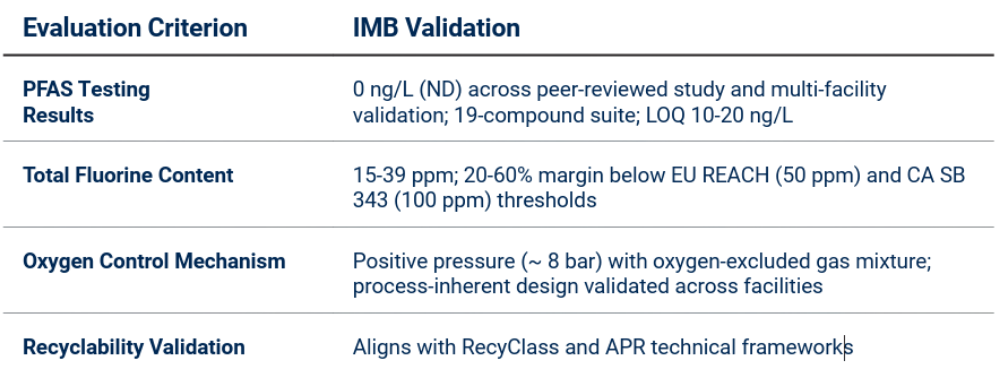
IMB’s Performance Against Process-Specific Evaluation Criteria:
IMBsPerformanceChart e1778174751615

This validation profile demonstrates that process-specific evaluation based on testing data and mechanism validation can distinguish fluorination technologies suitable for applications requiring demonstrated safety and compliance.

Benefits of Process-Specific Evaluation:

  • For Regulators: More accurate risk assessment based on empirical data; flexibility to distinguish validated technologies from those requiring heightened scrutiny.
  • For Manufacturers: Clear pathways to demonstrate compliance through reproducible testing; reduced regulatory uncertainty.
  • For Customers: Confidence that barrier selection is based on testing data; clear differentiation between technologies with demonstrated compliance and those under evaluation.


For regulatory bodies and technical committees:

Process-specific evaluation frameworks – distinguishing fluorination technologies based on validated PFAS testing, total fluorine content, and oxygen control mechanisms – enable accurate risk assessment and support innovation in barrier technologies with demonstrated safety profiles.

IMB provides a validated pathway for applications requiring fluorination performance with PFAS-compliant profiles and regulatory compliance. The data is reproducible. The mechanism is established. Regulatory frameworks should reflect this evidence through process-specific evaluation.

REFERENCES

  1. Vitale, S.A., et al. (2022). “An assessment of the potential for leaching of per- and polyfluoroalkyl substances from fluorinated and non-fluorinated HDPE containers.” Environmental Advances, 8, 100267. https://doi.org/10.1016/j.envadv.2022.100267
  2. Greif IMB Characterization Study (2025). Multi-facility PFAS and total fluorine testing at Murray, Kentucky (U.S.) and St. Étienne, France (EU). Independent laboratory analysis with validated analytical methods.
  3. European Chemicals Agency (ECHA) (2023). Annex XV Restriction Report: PFAS. Draft restriction proposal.
  4. California Senate Bill 343 (2021). Truth in Labeling for Recyclable Materials, Section 42370.2.
  5. RecyClass (Plastics Recyclers Europe). Recycling Certification Protocols. https://reyclass.eu
  6. Association of Plastic Recyclers (APR). Design for Recycling Guidelines. https://plasticsrecycling.org
  7. Progress in Organic Coatings, Vol. 61 (2008), pp. 192 – 204.
  8. Pure and Applied Chemistry, Vol. 81, No. 3, pp. 451-471 (2009).
  9. Kharitonov, A.P., et al. (2011). “Modification of ultra-high-molecular weight polyethylene by various f luorinating routes.” Journal of Polymer Science Part A: Polymer Chemistry. Vol. 49, No. 16, pp. 35593573. https://onlinelibrary.wiley.com/doi/10.1002/pola.24793
  10. Belov, N.A., et al. (2020). “Direct fluorination as a method of improvement of operational properties of polymeric materials.” Polymers, Vol. 12, No. 12, Article 2836. https://doi.org/10.3390/polym12122836
IHRE SPRACHE IST NICHT ANGEGEBEN?

Verwenden Sie Google Übersetzer, um Ihre Sprache aus der Liste über die Symbolleiste oben auf der Seite auszuwählen.