
PPWR Implementation Will Be Defined by Methodology, Not Targets
The conversation around PPWR is fundamentally changing from political agreement into implementation, with the first set of obligations becoming enforceable in August 2026.
The purpose of the regulation is clear; targets are largely set and initial timelines defined. The real focus now is no longer what PPWR aims to achieve – it is how those ambitions can be implemented across complex industrial systems in a way that is environmentally credible, operationally realistic, and economically scalable.
Why does this move from what to how matter?
Because the methodologies being shaped today – around reuse, recyclability, conformity, data, and responsibility allocation – will ultimately determine whether PPWR succeeds in practice or creates unintended consequences across European supply chains.
At Greif, we increasingly see our role extending beyond the packaging itself — helping customers navigate the technical, regulatory and operational complexities that PPWR implementation introduces across the value chain.
This commitment to navigating complexity was reflected at interpack, where Greif hosted a PPWR roundtable bringing together industry stakeholders including Dow, Ecolab, Coca Cola, Pepsi, Givaudan, PPG and Syngenta, alongside influencers from across the packaging ecosystem, including representatives from IK, EuPC, Elipso, EXPRA, CONAI, and SEFA.
The discussion reinforced a clear reality: the industry is not simply preparing PPWR compliance but is actively working to define what workable implementation looks like.
And that window for influence is still open.
1) The real debate is not reuse versus recycling – it is proportionality
There is consensus that reuse is desirable in principle, but the big challenge facing the industry is how to apply reuse requirements proportionally across industrial applications where safety, contamination risk, logistics, and environmental trade-offs vary significantly.
In industrial packaging applications – particularly chemical and food-contact systems – intensive cleaning processes, transport distances, and contamination risks can quickly erode the environmental benefits that reuse is intended to create. In some cases, local recycling systems may deliver a lower overall environmental footprint than centralized reuse loops requiring additional transport, cleaning, and handling infrastructure.
This is where frameworks become critical. The future implementation challenge is not simply achieving reuse targets, but defining credible frameworks for:
- proportional cleaning requirements,
- acceptable contamination thresholds,
- LCA-based exemptions,
- and evidence-based comparisons between reuse and recycling pathways.
Life Cycle Assessments (LCAs) can be an impactful tool in the process of operationalizing PPWR policy. Environmental evidence could become the mechanism through which policy ambition is translated into practical decision-making. This moves the industry’s conversation away from ideology and toward measurable environmental outcomes.
2) Classification methodology may become one of the most commercially important PPWR questions
Another major implementation challenge discussed was packaging classification — particularly the distinction between sales packaging and transport packaging in industrial contexts.
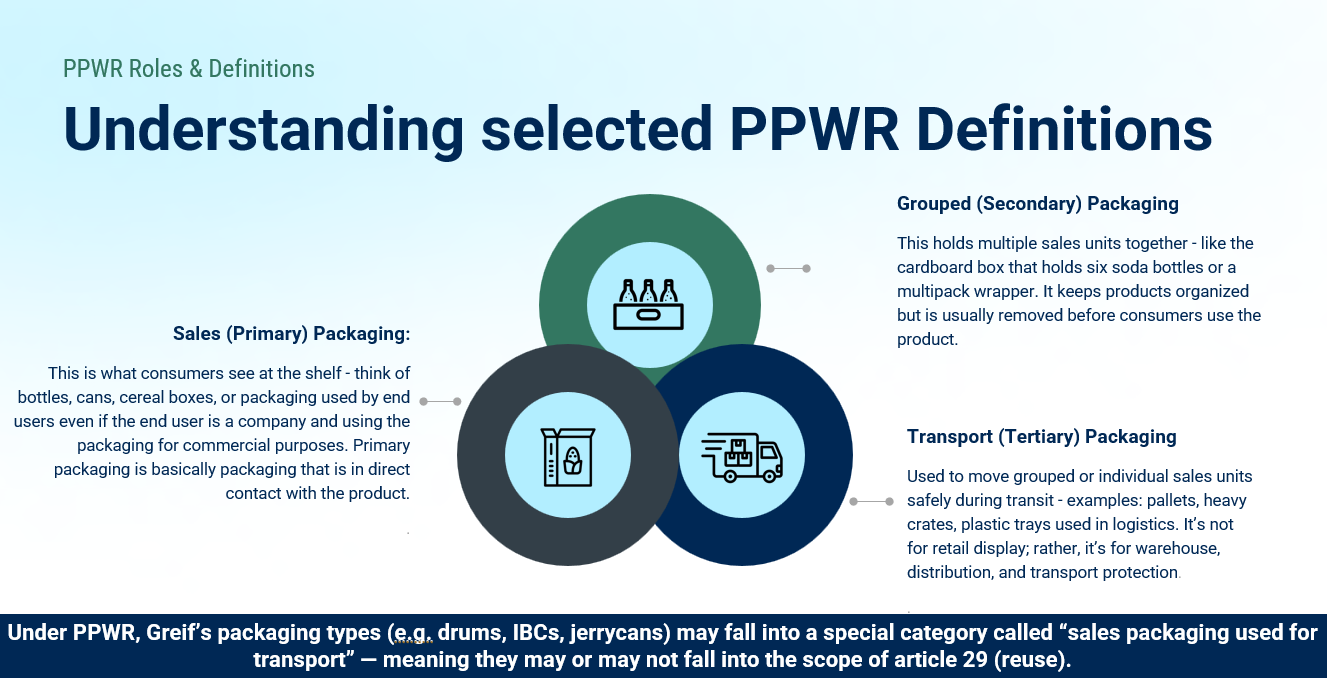
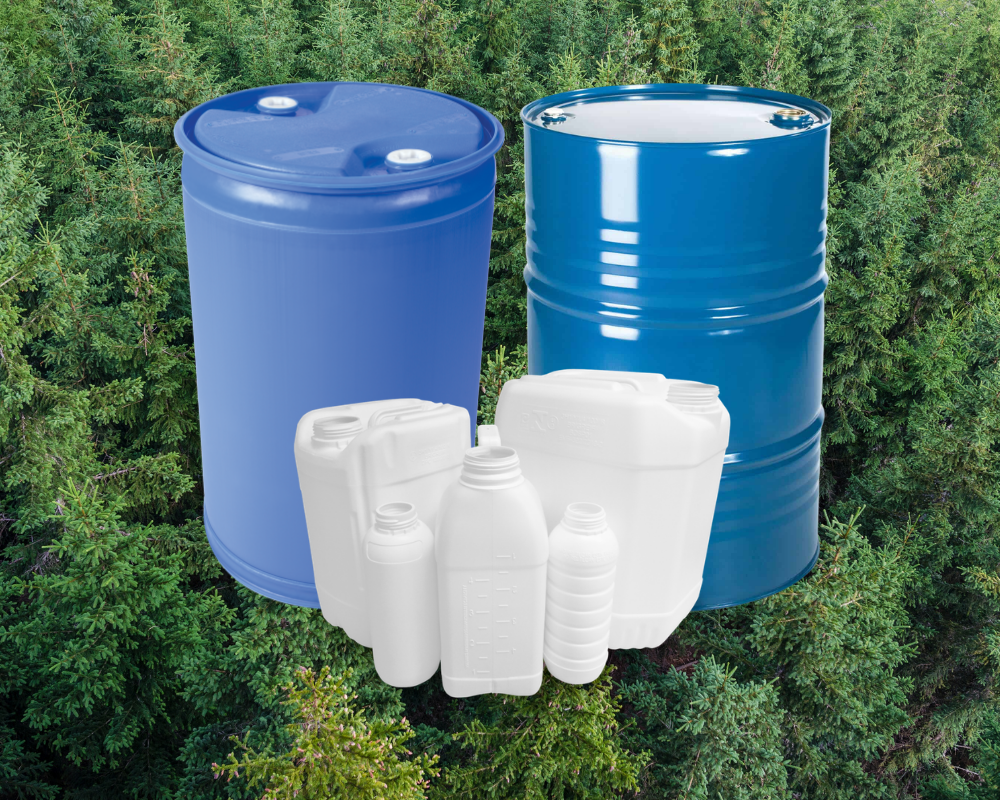
Under PPWR, the classification of certain industrial packaging formats remains an area of ongoing interpretation and debate. Formats such as IBCs, drums and canisters frequently serve multiple functions simultaneously: transport, storage, handling and product containment.
That ambiguity has direct implications for reuse obligations, reporting requirements and compliance strategies.
A consistent theme emerging from the discussion was the need for pragmatic classification methodologies before fragmented interpretations become embedded across member states and supply chains.
This is not just a legal interpretation issue — it is an operational alignment challenge with potentially significant socio-economic implications.
The challenge is not simply legal interpretation. It is operational consistency. If certain industrial formats are classified as transport packaging and become subject to reuse obligations that are not operationally feasible, companies may ultimately be forced to redesign packaging systems entirely — with downstream impacts across filling operations, logistics networks, and supply-chain economics.
Without shared conventions, companies risk:
- inconsistent declarations,
- duplicate compliance burdens,
- conflicting customer expectations,
- unnecessary administrative complexity,
- and avoidable disruption across industrial value chains.
3) Conformity and documentation must remain risk-based and operationally realistic
Documentation and conformity requirements are also becoming a priority area as the first PPWR obligations become enforceable in August 2026.
A key clarification emerging from the roundtable was that the Declaration of Conformity (DoC) should not be interpreted as an exhaustive technical file. Rather, it functions as the front-facing declaration supported by technical documentation held within the supply chain.
At the same time, ambiguity remains around ownership and responsibility for documentation relating to substances of concern — including adherence to PFAS and BPA limits — particularly where responsibilities sit between raw material suppliers, packaging suppliers, and downstream users.
Managing those documentation expectations will be critical to avoiding unnecessary administrative burdens and inconsistent compliance approaches across global packaging networks.
4) PPWR is becoming a data and systems challenge, not just a packaging challenge
Data is rapidly becoming both a compliance bottleneck and a strategic differentiator.
By 2026 and beyond, organizations will increasingly need to manage detailed packaging information across global supplier networks, including non-EU suppliers with limited direct regulatory exposure.
For many organizations — particularly SMEs — the capability gap to provide dedicated resources to PPWR implementation may become more significant than the material challenge itself.
At the same time, digital product passports and improved traceability frameworks also create an opportunity to build more transparent and standardized recyclability and recycled-content systems across the market.
The companies that invest early in packaging data governance will likely gain a significant implementation advantage as methodologies mature.
The “what” is defined. The “how” is still being written.
One of the clearest themes emerging from the roundtable was that PPWR implementation will not be shaped by regulation alone. Many of the practical frameworks are still being debated today — from reuse calculations and LCA criteria to packaging classification, grouping approaches, and data governance — will ultimately be influenced by how the industry operationalizes them in practice.
As a result, the companies moving fastest are not necessarily those waiting for complete regulatory certainty, but those already:
- engaging in methodology discussions,
- building evidence-based implementation models,
- aligning interpretations across stakeholders,
- educating customers and suppliers,
- and identifying where operational realities need to be better reflected in future guidance.
While the targets set the direction of travel, many of the methodologies and practical interpretations that will determine how PPWR works in practice are still evolving. This is where collaboration between industry, associations, and regulators will become increasingly important.
The industry must work together with a focus on bringing forward operational experience, environmental evidence, and pragmatic implementation models that can help policymakers refine methodologies, calibrate requirements where necessary, and translate policy ambition into workable systems at scale.
That is now the defining challenge and opportunity for the packaging industry.
Stay Informed on the Latest PPWR News
PPWR Declarations of Conformity Explained: Who Is Responsible and How to Prepare for August 2026
Unpacking PPWR: What Substances of Concern Mean for Your Market

PPWR kicsomagolása
Kapcsolat
Az Greif szigorú szabályzattal rendelkezik a spam ellen, és a cég képviselői nem válaszolnak a kéretlen e-mailekre.
Személyes adatainak feldolgozása a következővel összhangban történik: Greif weboldal adatvédelmi szabályzata
Adatvédelmi irányelvek megtekintése
A weboldalon a termékekről és szolgáltatásokról megadott adatok, méretek és információk névleges értékeknek minősülnek, amelyeket általános célú használatra szánnak a termékek és szolgáltatások ügyfelek konkrét alkalmazásaihoz való értékeléséhez. Ezek nem tekinthetők gyártási specifikációknak.
EZÚTON ELUTASÍTUNK ÉS KIZÁRJUK MINDEN KIFEJEZETT VAGY VÉLELMEZTETETT GARANCIÁT, BELEÉRTVE, KORLÁTOZÁS NÉLKÜL, AZ ELADHATÓSÁGRA ÉS EGY ADOTT CÉLRA VALÓ ALKALMASSÁGRA VONATKOZÓ VÉLELMEZTETETT GARANCIÁKAT.
Greif Etikai Segélyvonal
Ha bizalmasan és névtelenül szeretne bejelenteni az etikai vagy megfelelőségi szabálysértésekkel kapcsolatos aggályait, kérjük, látogasson el a következő oldalra: www.greif.ethicspoint.com Észak-Amerikában ingyenesen hívhatja a 866-834-1825-ös számot. Észak-Amerikán kívül, ahol elérhető, kövesse az itt található utasításokat: www.greif.ethicspoint.com az „Üzenet jelentése” alatt.
 English
  简体中文
简体中文  Português
  Deutsch
  Español
  Français
  עִבְרִית
  العربية
  Українська
  Polski
  Magyar
  Dansk
Dansk  Tiếng Việt
  Nederlands (België)