
Barrier Technologies
IMF
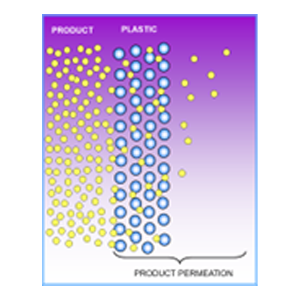
In the blow molding of bottles, use Fluorine (F2) & Nitrogen (N2) to inflate the parison in the molding process. The F2 replaces the Hydrogen (H2) in the Polyethylene (PE) to create a Carbon (C2)/F2 compound.
POST-MOLD FLUORINATION
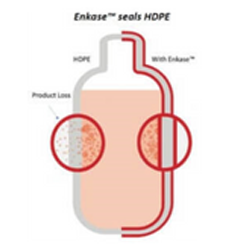
Post fluorination is performed after a bottle is produced. Bottles are loaded into a large chamber that are heated and fluorine introduced and after a period of time a similar reaction occurs as with In-Mold fluorination. Both the inside and outside of the bottles surface are treated.
PLASMA FLUORINATION
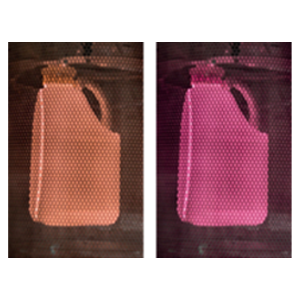
Plasma technology currently uses a fluorine based refrigerant in the process to create a fluoropolymer barrier layer. Both the inside and outside of the bottles surface is treated.
BARRIER RESINS
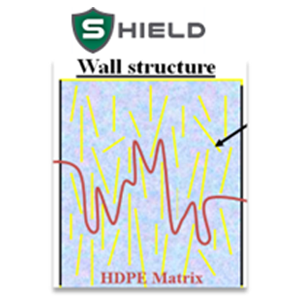
Laminar barrier resins, Polyamide (PA), e.g. Nylon are added to the PE prior to the molding process and platelets with the PE are created that restricts the migration of solvents through the bottle.
CO-EXTRUSION
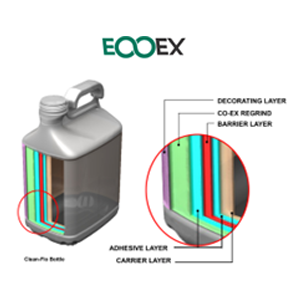
The technology combines barrier resins Polyamide (PA) or Ethylene vinyl alcohol (EVOH) with adhesive and PE to create a multilayer barrier structure.
|
BARRIER PROPERTIES |
CONTAINER SIZE |
SUSTAINABILITY & PROCESSABILITY |
REGULATORY |
HISTORY |
WHERE OFFERED |
|
|
IN-MOLD FLUORINATION |
Fluorination is the North American standard for Crop Protection for barrier properties. |
1L - 30L (1qt - 8USG) |
High on sustainability scale, low environmental footprint, no known issues with recycling. |
Regulatory agencies have identified the formation of PFAS chemistries during certain fluorination processes when oxygen is present. In-mold fluorination uses nitrogen and fluorine gases. |
Technology developed by Air Products called Airopak in 1978. |
North America & future Europe/Asia |
|
POST-MOLD FLUORINATION |
Fluorination is the North American standard for Crop Protection for barrier properties. |
1L - 208L (1qt to 55USG) |
Additional production steps as compared to IMF technologies. Lee Container has limited environmental impact with no additional freight required. No issues with recyclability. Process controlled by 3rd party. |
Regulatory agencies have identified the formation of PFAS chemistries during certain fluorination processes when oxygen is present. Post-mold fluorination processes subcontracted by Greif primarily uses Nitrogen and Fluorine gases. Greif’s subcontractor, Inhance Technologies, is currently in a legal dispute with the U.S. EPA related to its manufacturing processes. |
Technology developed in the 1950’s. |
North & South America |
|
PLASMA FLUORINATION |
Internal testing has shown that the technology produces acceptable results but very limited exposure and real world testing within the market. |
1L - 20L (1qt - 5USG) |
Environmental foot print is slightly higher than in-mold and Co-Ex. No known issues with recycling. |
Plasma Fluorination uses refrigerant R134a (CF3CH2F), in the presence of Oxygen, to produce its barrier layer in bottles. This technology has not been singled out by the EPA as producing PFAS. New, Fluorine free technology is being developed. |
Technology of microwave plasma deposition process on rigid HDPE packaging developed in 2005 by Isytech. |
Ameryka Południowa |
|
BARRIER RESINS (SHIELD) |
Barrier properties are being evaluated in thin wall bottles within Crop Protection. Jerrycan, drums and IBC barrier properties have been approved as an effective barrier. |
20L - 1250L (5USG - 330USG) |
Low environmental footprint, many examples are shown to be recyclable. |
Not applicable. Technology does not produce PFAS. |
Technology commercially available since the 1980's by DuPont. |
Worldwide |
|
CO-EXTRUSION (ECOEX) |
Excellent barrier properties widely used in North American barrier containment in fuel containers. In North America, technology starting to be approved in Crop Protection. |
0.1L -20L (3.4oz. - 5USG) |
Similar to in-mold on environmental footprint, some known difficulties with recyclability with Co-Ex, ECOEX resolves the recyclability difficulties and enables bottle to bottle recycling. |
Not applicable. Technology does not produce PFAS. |
Co-Extrusion or Multilayer blow molding has been used commercially available since the 1970's. |
COEX: Europe & South America; future North America ECOEX: Latin America |
Version dated 12/14/23
The summary above is intended for evaluation by the customer and does not relieve the customer of the ultimate responsibility for the determination of the appropriate packaging for the customer’s use. It is the customer’s responsibility to select the appropriate packaging based upon all information at its disposal including the specific application, regulatory compliance, product compatibility and shipping requirements. NINIEJSZYM ZRZEKAMY SIĘ I WYŁĄCZAMY WSZELKIE WYRAŹNE LUB DOROZUMIANE GWARANCJE, W TYM MIĘDZY INNYMI DOROZUMIANE GWARANCJE PRZYDATNOŚCI HANDLOWEJ LUB PRZYDATNOŚCI DO OKREŚLONEGO CELU.
 English
  简体中文
简体中文  Português
  Deutsch
  Español
  Français
  עִבְרִית
  العربية
  Українська
  Polski
  Magyar
  Dansk
Dansk  Tiếng Việt
  Nederlands (België)